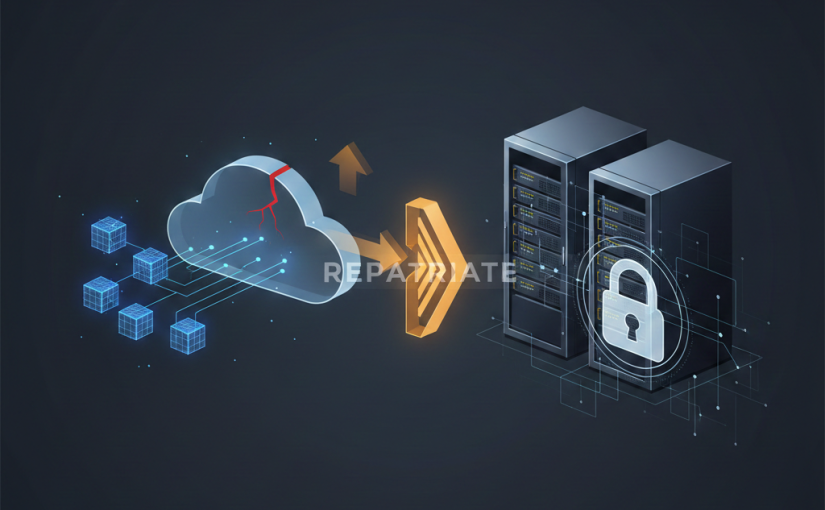
The “Cloud-First” mandate, once the unquestionable mantra of digital transformation, has begun to show cracks. For years, the message from the top-down was simple: migrate everything to the public cloud. As systems administrators, IT managers, and DevOps engineers, we executed that vision, often burning the midnight oil integrating, refactoring, and managing multi-cloud sprawl.
But now, a quieter, more critical conversation is emerging in the server room and the boardroom: the topic of Cloud Repatriation—or the strategic and tactical process of moving workloads out of the public cloud and back to private cloud, hybrid, or on-premises infrastructure.
If the thought of facing another unpredictable, eye-watering monthly bill, or having your data held hostage by crippling egress fees, sparks a feeling of urgency or even relief, you are not alone. That unpredictable financial anxiety, coupled with a subtle but definite loss of operational control, is the key pain point driving this strategic shift.
The Root Cause: Why Cloud Costs and Complexity Became Unmanageable
The core issue isn’t that cloud providers like AWS, Azure, or Google Cloud are inherently bad; they are powerful tools. The problem stems from two interconnected failures: a flawed organizational strategy and unforeseen technical costs that ballooned exponentially.
Organizational Flaw: The ‘Lift-and-Shift’ Trap
Early cloud migration was often sold as a simple “lift-and-shift” operation to accelerate IT objectives. Management prioritized speed-to-cloud over architectural efficiency. The technical team was often tasked with simply mirroring their virtual machines (VMs) in the cloud without refactoring them to use cost-optimized, cloud-native services.
The Result: You were still paying for a VM that behaved like an on-premises server, but now with a premium for the managed service, plus the hidden costs of I/O, API calls, and—the budget killer—data egress. This created an operational debt where teams were focused on service delivery, but the underlying cost model was fundamentally broken.
Technical Cost: The Triple Threat of Lock-In
At the infrastructure level, the loss of control and the surge in spending can be traced to three technical mechanisms:
-
Vendor Lock-In via Managed Services: Using a cloud provider’s proprietary database (e.g., Amazon Aurora or a specialized Azure service) creates deep dependencies. Moving that workload later means not just migrating data, but completely re-architecting the application. This gives the provider immense leverage on pricing.
-
The Egress Fee Tax: This is the most financially punitive component. You can put data into the cloud cheaply, but trying to move it out—to another cloud, a partner, or your own data center—incurs a fee. This is the financial moat that keeps your data within their “walled garden,” making a cloud exit a costly, but necessary, endeavor to avoid future, recurring penalties.
-
Untamed Storage & Decommissioning Debt: Storage simplicity leads to chaos. Teams over-provision, neglect lifecycle policies, and fail to properly decommission old virtual assets. Many systems administrators are paying thousands monthly for orphaned S3 buckets, unattached EBS volumes, or defunct snapshots that no one has the time or permissions to clean up.
Regaining Infrastructure Ownership: The Hybrid Cloud Strategy
Cloud Repatriation is not about abandoning the cloud entirely; it’s about moving to a calculated, balanced Hybrid Cloud Architecture. This model strategically places workloads where they make the most sense based on cost predictability, security requirements, and performance needs.
What Workloads Should You Repatriate?
IT managers and architects should target workloads that exhibit the following traits:
-
Predictable, High-Volume Compute: Stable, baseline workloads (e.g., core financial systems, established ERP, constant API gateways) that run 24/7. These eliminate the key benefit of public cloud elasticity and are almost always cheaper to run on-premises using optimized virtualization (like VMware vSphere or Red Hat OpenShift for containers).
-
Massive Data Stores with High Egress/I/O: Large petabyte-scale archives or data lakes that are frequently accessed (read/write intensive) or require constant transfer to analytics platforms. Moving these back immediately cuts the recurring egress fee.
-
Compliance-Mandated Data Sovereignty: Data that must remain within strict geographical or regulatory boundaries (GDPR, HIPAA). While public clouds offer region-specific controls, owning the physical boundary provides the highest level of control and simplifies audits.
Best Practices for a Secure Cloud Exit Strategy
A successful repatriation project is essentially a migration project in reverse—and it must be treated with the same rigor, if not more, given the critical nature of the workloads.
1. Perform a Full Cost of Ownership (TCO) Audit
Before moving a single byte, you must build a clear business case for the cloud exit.
-
Action: Calculate the true cost of the public cloud workload (including compute, storage, egress, API calls, and the cost of the DevOps/FinOps staff managing the bill).
-
Action: Calculate the true cost of running the workload on-premises (hardware depreciation, power, cooling, software licensing, and existing administrative staff overhead).
-
Insight: Remember to factor in the cost of new tooling. While you may have existing infrastructure, you might need a new Cisco firewall or a more robust CrowdStrike license to cover the repatriated boundary.
2. Adopt a Hybrid/Multi-Cloud Identity Standard
Security cannot be an afterthought. The moment you introduce a new environment, you expand your attack surface.
-
Action: Implement identity governance using an open standard like OAuth 2.0 or SAML, managed by a centralized Identity Provider (IdP), independent of your cloud provider’s native IAM (e.g., using Microsoft Entra ID or an open-source solution).
-
Insight: The NIST SP 800-204 series on hybrid cloud architecture provides excellent guidance on ensuring consistent authorization and authentication across boundaries. Your goal is to move the data, not the identity mess.
3. Master the Secure Decommissioning of Cloud Assets
The single biggest mistake in repatriation is failing to fully decommission the source resources. You are still paying for them!
-
Action: Decommission in phases: Shut down the application, remove the compute, then remove the storage, and finally, remove the networking elements (VPC/VNet peerings, load balancers, security groups).
-
Security: Before deleting the data, ensure secure, compliant archival. For critical systems, refer to CISA’s guidance on data disposal. Use multi-pass deletion or verified encryption key deletion where required. This is also where an IT team might invest in a resource like the CompTIA Cloud+ Certification Study Guide on Amazon to ensure the whole team is aligned on best-practice lifecycle management and secure decommissioning.
4. Design for Cloud-Agnostic Infrastructure
To prevent future lock-in, use platform-agnostic technologies in your repatriated environment.
-
Containers: Use Kubernetes (whether through Red Hat OpenShift, VMware Tanzu, or a vanilla distribution) to package applications. This makes them portable, allowing you to move them easily between your on-premises virtual environment and any public cloud in the future, maintaining optionality.
-
Infrastructure-as-Code (IaC): Use tools like Terraform or Ansible to define your repatriated infrastructure. If you ever need to burst to the cloud again, the blueprints are ready to deploy instantly.
💡 Failure Scenario: The Incomplete Cloud Exit
Consider a mid-sized IT firm that repatriated its core transactional database (high I/O) to save on costs. They successfully migrated the data and compute.
The Failure: They forgot to update the configuration of several older, non-critical logging microservices that were still running on a public cloud function service. These orphaned services were configured to send massive, continuous streams of diagnostic data back to the new on-premises database. The result? They cut the core database cost, but immediately replaced it with equally crushing, unexpected data egress charges from the logging microservices, simply because the old dependencies were never fully documented and severed.
This is a powerful example of why the Cloud Exit Checklist must be comprehensive, tracking every dependency—right down to the forgotten cron job or monitoring agent—before the final kill-switch is thrown.
The Proactive Sysadmin’s Mindset
Regaining infrastructure ownership is a defining strategic initiative for the modern IT professional. It signals a move away from simply being a consumption manager and back toward being a true infrastructure architect.
This shift empowers you to offer the business a more predictable, secure, and financially sound platform. It restores the principle that the infrastructure should serve the business, not the other way around.
By conducting a rigorous TCO analysis, implementing strong identity controls, and embracing open, cloud-agnostic technologies, you can strategically leverage the cloud for elastic needs (like disaster recovery or seasonal scaling) while reserving your core, predictable, and sensitive workloads for your own secure, optimized domain.
The time to act is now. Don’t wait for the next shock bill to force an urgent, panic-driven move. Start the TCO audit today and present a proactive, cost-control strategy to your management. Share this guide with your DevOps and finance colleagues—this is a shared journey that requires collective expertise to ensure true, long-term infrastructure resilience.
Recommended Resource for Cloud Governance & Decommissioning Best Practices: